It was the question I was asked more than any other before travelling to the United Nations AI for Good Global Summit in Geneva. Friends asked it over coffee, colleagues asked it in meetings, and more than one person wondered whether I was about to discover that bookkeepers were destined to be replaced by humanoid robots.
Having now spent a week surrounded by some of the world's leading AI researchers, entrepreneurs, policymakers and engineers, I can offer some reassurance.
Robots are not about to take over the world, and they are certainly not coming for your bookkeeping practice any time soon. They are, however, surprisingly good at dancing.
Beneath that entertainment sat a much more important story. We are witnessing an acceleration of scientific discovery that extends far beyond artificial intelligence. AI is acting as a catalyst, enabling researchers to solve problems more quickly, test ideas faster and connect disciplines that have traditionally evolved independently. The result is a rate of progress that is genuinely difficult to comprehend until you see it unfolding in front of you. During one morning alone I watched demonstrations of AI-powered exoskeletons helping people living with paralysis regain movement, Brain AI² combining nanotechnology with living immune cells to target inflammation, robots equipped with artificial skin capable of sensing touch, multilingual AI systems supporting farmers, and workshops exploring quantum computing alongside quantum AI. Individually, each innovation was remarkable. Together they painted a picture of scientific disciplines converging at a pace few of us have experienced before.
The same pattern emerged throughout the summit. Researchers, clinicians, educators, governments, charities and businesses had travelled from every corner of the world, each applying AI to very different challenges. Alzheimer's disease, inflammatory bowel disease, humanitarian aid, education, accessibility, disaster response, food security and business transformation all featured during the week. Every presentation began in the same place: identifying a human problem worth solving.
Artificial intelligence is rarely out of the headlines without someone highlighting its risks, and those risks are real. Environmental impact, governance, transparency, security and ethics featured prominently throughout the summit. Rather than slowing innovation, those discussions recognised that trust is what allows innovation to flourish. The technology and the frameworks that govern it need to develop together.
One of the most thought-provoking keynote sessions came from Will.i.am. Standing before an audience immersed in discussions about robotics, quantum technologies and artificial intelligence, he barely spoke about technology itself. Instead, he spoke about learning.
"Education is forever."
A few moments later he smiled and added,
"What an amazing time to be a student."
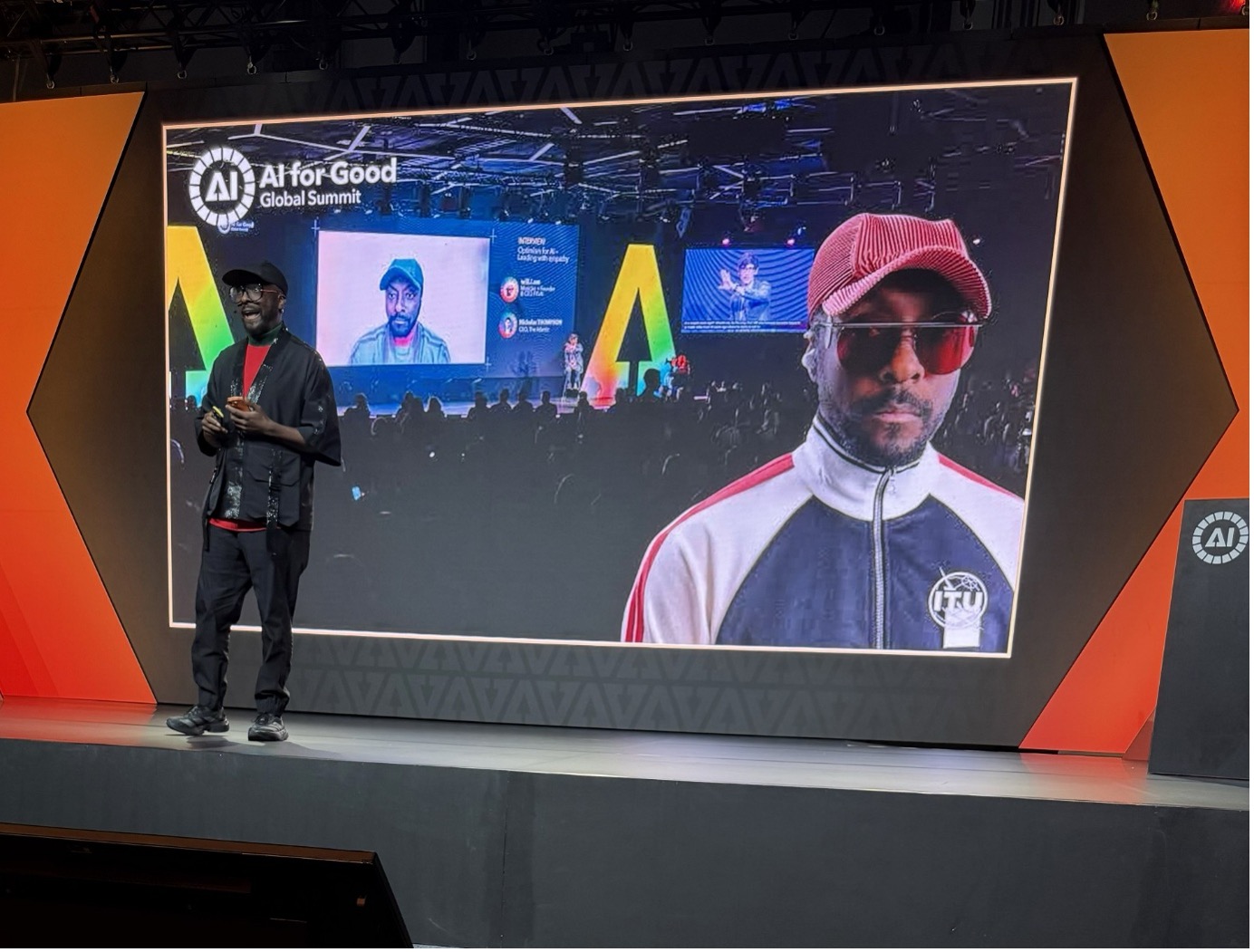
(I captured this image with my AI glasses so that I could remain present in the room)
His message resonated because it reflected something much bigger than education alone. Professional expertise is becoming increasingly dynamic. Knowledge is expanding so rapidly that continuous learning is no longer something we fit around our careers. It is becoming part of our careers.
For ICB members and students, that should feel remarkably familiar.
Bookkeepers have never stood still. We have adapted through digital accounting, cloud software, Making Tax Digital and changing regulatory frameworks. Artificial intelligence represents another stage in that evolution. It will undoubtedly automate repetitive processes, analyse information at extraordinary speed and create efficiencies across every sector of the economy. At the same time, it places an even greater value on the qualities that clients have always relied upon: professional judgement, integrity, communication, commercial awareness and the ability to translate complex information into confident business decisions.
One workshop introduced a principle that I suspect will stay with me for a long time. Every successful AI project should begin with local knowledge rather than technology. Businesses already understand their customers, their markets and the challenges they face. AI creates its greatest value when it strengthens that understanding rather than attempting to replace it. The technology may be global, but successful implementation is always grounded in real organisations solving real business problems.
The learning did not stop when the presentations ended. After one particularly intense morning immersed in workshops on quantum computing and quantum AI, I walked through the botanical gardens to the shores of Lake Geneva to give myself time to reflect on everything I had heard. Sitting quietly beside the lake with my notebook.
Somewhere during that process, a particularly friendly duck wandered over and settled beside me while preening her feathers. It was an unexpected moment of calm, and one that reminded me that the purpose of innovation is ultimately to improve the world beyond the conference hall.

(full video available on my linkedin)
Hours spent discussing technologies that may shape the future were followed by complete stillness beside the lake. Looking across the water towards the Alps, it became much easier to appreciate what all that innovation is ultimately intended to protect. Progress has never been an end in itself. Its purpose is to improve lives, strengthen businesses, support society and leave the world in a better condition than we found it.
Perhaps that is the greatest lesson I brought home from Geneva. Artificial intelligence is an extraordinary enabler, but its value will always be measured by something far more important than technological sophistication. It will be measured by whether it helps people, businesses and society flourish together.
Education is forever.
I have a feeling Will.i.am is right. For anyone working in bookkeeping today, there has never been a more exciting time to keep learning.